


Orders
.png&w=48&q=75 "login")
Profile


Wallet

3 Main Causes of Acne, and What Actually Works


BDS (Gold Medalist), Certified Lactation Consultant – BPNI Delhi, Maternal & Infant Nutrition Expert · 15 years experience
 2 Likes|
 15 min
AI-Generated Summary
Quick overview in 30 seconds.webp&w=32&q=75)
- Acne is a common skin condition characterized by pimples, blackheads, whiteheads, papules, and pustules, affecting people of all ages, not just teenagers.
- The three main causes of acne are excess sebum production, inflammation triggered by certain cosmetics, and hormonal imbalances often linked to diet.
- Treatment options include over-the-counter medications like benzoyl peroxide and salicylic acid, oral antibiotics, retinoid creams, and non-surgical therapies for severe cases.
- Looking for gentle skincare to manage acne-prone skin? Explore our Vitamin C Moisturizer - 100 gm.
 4.3
4.3Quick answer
Acne has three underlying causes working together: excess oil production driven by hormones, pores blocked by dead skin cells, and bacteria that trigger inflammation. Everything else, including diet, cosmetics and stress, makes it worse rather than causing it. Treatment depends on severity, and several common acne ingredients need changing during pregnancy and breastfeeding.
Key takeaways
Acne is not caused by poor hygiene. Over-washing and scrubbing make it worse by damaging the skin barrier.
Hormones drive the oil production that starts the process, which is why acne appears in teenage years, in pregnancy, after delivery and with PCOS.
If you are pregnant or trying to conceive, this matters urgently. Oral isotretinoin causes serious birth defects, and several common acne treatments need changing.
Never use a steroid cream for acne. Topical steroids are widely sold over the counter in India for pimples and fairness, and they cause steroid-induced acne and long-term skin damage.
On Indian skin, irritation itself causes dark marks. Gentle treatment works better here, and picking a spot leaves a mark that outlasts the spot by months.
What is acne?
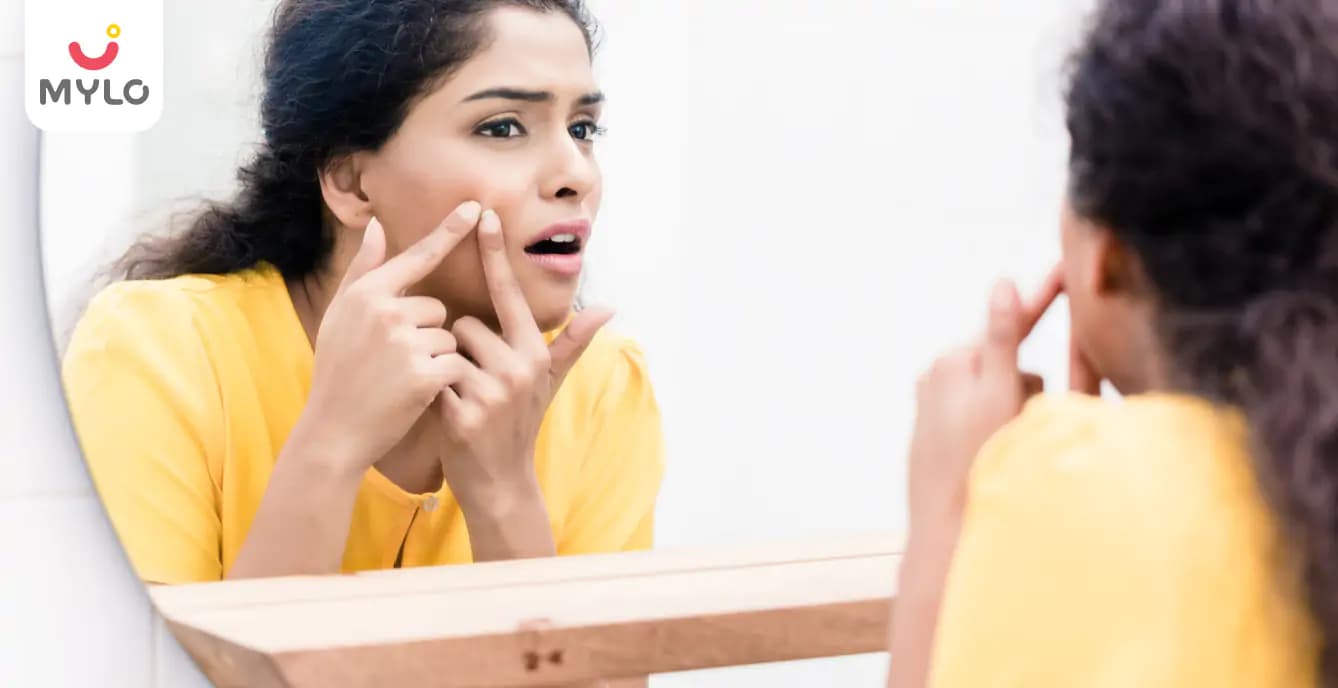
Acne happens when hair follicles, the tiny openings in your skin, become blocked. Each follicle has an oil gland attached to it, and when oil and dead skin cells accumulate inside, the follicle becomes plugged, inflamed, or both.
It is a medical condition, not a hygiene failure, and it affects people of every age. Adult acne is common, and acne that starts or worsens in your twenties and thirties is usually hormonal rather than a sign that you are doing something wrong.
The 3 main causes of acne
These three happen together. Treatment works by targeting one or more of them, which is why understanding them makes the treatment choices below make sense.
1. Excess oil (sebum) production
Oil glands in the skin produce sebum, which normally keeps skin lubricated. Hormones, particularly androgens, increase how much sebum those glands produce. More oil means more raw material to block the follicle.
This is why acne flares at times of hormonal change: puberty, around periods, in pregnancy, after delivery, and in conditions such as PCOS.
2. Blocked pores
The lining of the follicle sheds dead skin cells continuously. In acne-prone skin, those cells shed abnormally and stick together, forming a plug inside the follicle rather than clearing away.
A plug near the surface that stays open becomes a blackhead. The dark colour is oxidised pigment, not dirt, which is why scrubbing does not remove it. A plug that stays closed becomes a whitehead.
3. Bacteria and inflammation
A bacterium that lives normally on everyone's skin, Cutibacterium acnes, multiplies in the oil-rich, blocked follicle. Your immune system responds, and that response is what turns a blocked pore into a red, swollen, painful spot.
Inflammation is why acne hurts, why it leaves marks, and why anti-inflammatory treatments help.
What makes acne worse
These are aggravating factors rather than causes, but several of them are specific to India and are worth knowing.
Factor | What happens |
|---|---|
Hair oils on the forehead and hairline | Coconut, mustard and other heavy hair oils migrate onto the skin and block pores. This pattern along the forehead and temples is extremely common and frequently missed |
Helmet and mask friction | Pressure, heat and sweat under a two-wheeler helmet or a face mask causes acne along the jaw, chin and cheeks |
Heat, humidity and sweat | Sweat trapped under clothing or equipment, especially in Indian summers and monsoon |
Heavy or comedogenic cosmetics | Thick foundations, oil-based makeup, and not removing makeup properly |
Picking and squeezing | Pushes inflammation deeper, and causes scarring and dark marks |
Scrubbing and over-washing | Damages the skin barrier, increases irritation, and makes acne worse rather than better |
Steroid creams | See the warning below. A major and under-recognised cause of acne in India |
Certain medications | Steroids, some hormonal treatments, lithium, and some anti-epileptics |
Bodybuilding supplements and anabolic steroids | A common cause of sudden severe acne on the back and shoulders in young men |
Hormonal conditions, especially PCOS | See the section below |
Diet | High-sugar, high-glycaemic foods and possibly dairy are associated with acne in some studies. The effect is modest, and diet is not the main driver |
Stress and poor sleep | Genuine aggravators, though not causes |
Types of acne
Type | What it looks like | General approach |
|---|---|---|
Blackheads (open comedones) | Small dark plugs, usually nose, forehead, chin | Topical retinoid or salicylic acid |
Whiteheads (closed comedones) | Small skin-coloured or white bumps | Same |
Papules | Small red, tender bumps without a head | Topical treatment, often combination |
Pustules | Red bumps with a white or yellow centre | Topical treatment, often combination |
Nodules | Large, deep, firm, painful lumps | See a dermatologist. Needs prescription treatment |
Cysts | Deep, soft, pus-filled, painful | See a dermatologist promptly. High scarring risk |
Nodules and cysts should not be managed with over-the-counter products. They scar, and the scarring is preventable with early treatment.
Acne in pregnancy and while breastfeeding
This is the section to read before buying anything if you are pregnant, trying to conceive, or feeding.
Acne is common in pregnancy and very common in the months after delivery, when oestrogen drops sharply. Several standard acne treatments are not suitable at these times.
Treatment | Pregnancy | Breastfeeding |
|---|---|---|
Oral isotretinoin | Absolutely contraindicated. Causes serious birth defects. Pregnancy must be strictly avoided during treatment and for a period afterwards, and effective contraception is required | Not used |
Topical retinoids (tretinoin, adapalene, retinol) | Commonly advised to avoid | Limited data. Many doctors defer until after weaning. Never apply near the breast |
Oral tetracyclines (doxycycline, minocycline) | Avoided, particularly after the first trimester | Generally avoided |
Hormonal treatments (combined pill, spironolactone) | Not used in pregnancy | Discuss with your doctor. Some affect milk supply |
Azelaic acid | Often the first choice. Treats acne and pigmentation together | Generally considered compatible |
Benzoyl peroxide (topical) | Widely used. Minimal absorption | Generally acceptable. Never on or near the breast |
Topical clindamycin or erythromycin | Commonly used | Generally acceptable |
Salicylic acid, low strength and wash-off | Generally accepted at cosmetic strengths | Generally accepted. Avoid high-strength, large-area use |
Chemical peels and lasers | Usually deferred | Usually deferred. A dermatologist's decision |
⚠️ Every position above must be confirmed with your own dermatologist and obstetrician, and checked against LactMed for lactation. Do not act on a table alone.
Three practical rules:
Tell your dermatologist you are pregnant, trying to conceive, or breastfeeding, before any prescription is written. This is not a detail to mention afterwards.
Wash your hands before every feed if you have applied an active. Transfer from fingers to nipple is the most realistic exposure route, and it is more relevant than systemic absorption.
If you are on isotretinoin and considering pregnancy, this must be planned with your dermatologist well in advance.
Acne and PCOS
Acne alongside irregular periods, excess facial or body hair, hair thinning at the scalp, or difficulty losing weight may point to polycystic ovary syndrome, which is common in Indian women.
This matters because treating the skin alone misses the underlying condition, and PCOS also affects fertility, blood sugar and long-term metabolic health.
Ask your doctor about it if your acne started or worsened in your twenties, sits mainly along the jawline and chin, flares strongly around your cycle, and comes with any of the signs above. Our guide to causes of a delayed period covers the wider picture.
What actually treats acne
Treatment is chosen by severity, and results take time. Most acne treatments need 8 to 12 weeks before you can judge them, and skin often looks slightly worse in the first few weeks.
Severity | Typical approach |
|---|---|
Mild, mostly blackheads and whiteheads | Gentle cleanser twice daily, non-comedogenic moisturiser, and a topical retinoid or salicylic acid |
Mild to moderate, with red spots | Add benzoyl peroxide, or a combination topical product |
Moderate, not responding to topicals | Prescription combinations, sometimes a course of oral antibiotics used alongside a topical, not alone |
Hormonal pattern in women | Hormonal treatments such as the combined pill or spironolactone, prescribed and monitored |
Severe, nodular or cystic, or scarring | Dermatologist referral. Oral isotretinoin may be considered, with strict monitoring |
Marks left behind | Sunscreen first, then treatments for pigmentation or scarring once active acne is controlled |
Two things worth knowing about antibiotics. Oral antibiotics for acne should be used for a limited period, usually around three months, and should be combined with benzoyl peroxide or a topical retinoid rather than used alone. Long courses of antibiotics by themselves drive antibiotic resistance without controlling the acne.
The basic routine underneath all of this: gentle cleanser twice a day, a non-comedogenic moisturiser, and daily sunscreen. Skipping moisturiser because your skin is oily is one of the most common mistakes, and it makes treatment harder to tolerate.
What not to do
Never use a steroid cream on acne.
Topical steroid creams are widely available over the counter in Indian pharmacies, often in combination products sold for pimples, dark spots or fairness. They appear to work for a few days and then make things considerably worse.
What they cause: steroid-induced acne, thinning skin, visible blood vessels, increased facial hair, a rosacea-like rash, and a rebound flare that is worse than the original problem when you stop. The damage can take months to reverse and is sometimes permanent. Indian dermatology bodies have campaigned specifically against this misuse.
If a cream was recommended by a pharmacist or a friend rather than a dermatologist, check the ingredients, and look for names ending in "-sone" or "-onide" such as betamethasone, clobetasol, mometasone or fluocinolone.
Also avoid:
Picking, squeezing or popping. The strongest predictor of scarring and dark marks
Harsh scrubs, including homemade besan and sugar scrubs. Friction worsens both acne and pigmentation
Lemon juice on the skin. Acidic, irritating, and can cause pigmentation with sun exposure
Toothpaste on spots. Irritating, with no benefit
Multiple actives at once. Starting three products together usually just irritates the skin
Unlabelled or repackaged "fairness" creams. Some have been found to contain steroids or mercury
Heavy hair oil on the forehead and hairline if you have acne there
Over-washing. Twice a day is enough
Marks and scars on Indian skin
On Fitzpatrick IV to V skin, which covers most Indian skin tones, inflammation itself produces pigmentation. A spot that heals can leave a brown mark that lasts for months, and that mark is often what bothers people more than the original acne.
Two consequences:
Gentle genuinely works better here. Aggressive treatment and irritation create the marks you are trying to avoid. This is not a compromise, it is the correct approach for this skin type
Daily sunscreen is part of acne treatment, not a separate concern. UV exposure deepens post-inflammatory marks and slows their fading
Dark marks fade slowly on their own, over months. True scars, which are indented or raised, do not, and they need dermatologist-led treatment. Treating active acne early is the only reliable way to prevent them.
When to see a dermatologist
Book an appointment if:
You have deep, painful nodules or cysts
Acne is leaving marks or scars
Over-the-counter products have not helped after about 8 to 12 weeks
Acne is affecting your mood, confidence or social life. This is a legitimate medical reason, not a vanity one
It started or worsened suddenly in adulthood
It comes with irregular periods, excess hair growth or scalp hair thinning
You are pregnant, trying to conceive or breastfeeding and need treatment
You have been using a steroid cream on your face
Acne appeared after starting a medication or supplement
Seek prompt care for: a sudden severe eruption with fever or joint pain, painful swollen areas that are spreading, or a rash that is not typical acne.
Frequently asked questions
What are the 3 main causes of acne?
Excess oil production driven by hormones, pores blocked by dead skin cells, and bacteria that trigger inflammation. All three work together.
Does eating oily food cause pimples?
Not directly. Some studies link high-sugar and high-glycaemic diets, and possibly dairy, with acne, but the effect is modest. Diet is not the main driver.
Is acne caused by not washing your face?
No. Acne is not a hygiene problem, and over-washing or scrubbing makes it worse by damaging the skin barrier.
Can I use acne treatment while pregnant?
Some, yes. Azelaic acid, benzoyl peroxide and topical clindamycin are commonly used. Oral isotretinoin is absolutely contraindicated, and topical retinoids and oral tetracyclines are generally avoided. Always tell your doctor you are pregnant.
Why did my acne start after delivery?
The sharp drop in oestrogen after birth leaves androgen activity relatively unopposed, which increases oil production. Postpartum acne is common even in women who never had it before.
Is a steroid cream good for pimples?
No. Steroid creams cause steroid-induced acne and long-term skin damage, and they are one of the most common causes of worsening acne in India. Never use one on acne.
How long does acne treatment take to work?
Usually 8 to 12 weeks before you can judge it fairly. Skin sometimes looks slightly worse in the first few weeks.
Will squeezing a pimple make it heal faster?
No. It pushes inflammation deeper, delays healing, and is the single biggest cause of scarring and dark marks.
Does hair oil cause acne on the forehead?
It can. Heavy hair oils migrate onto the skin and block pores, producing a characteristic pattern along the forehead and hairline. Keep oil off the scalp margin if you have acne there.
Can acne be a sign of PCOS?
It can, particularly with irregular periods, excess facial or body hair, or scalp hair thinning. Ask your doctor about assessment rather than treating the skin alone.
The bottom line
Acne comes down to three things happening together: too much oil, blocked pores and inflammation from bacteria. Everything else, including diet, cosmetics and stress, makes it worse rather than causing it. Treat it gently, give any treatment eight to twelve weeks before judging it, and never use a steroid cream on your face. If you are pregnant, trying to conceive or breastfeeding, say so before any prescription is written, because that single sentence changes which treatments are appropriate.
Sources
American Academy of Dermatology, guidelines of care for the management of acne vulgaris
British Association of Dermatologists, acne guidance
National Institute for Health and Care Excellence, acne vulgaris: management
Indian Association of Dermatologists, Venereologists and Leprologists (IADVL), acne guidance and position on topical steroid misuse
National Institutes of Health, LactMed, Drugs and Lactation Database
Royal College of Obstetricians and Gynaecologists and American College of Obstetricians and Gynecologists, medication safety in pregnancy
Peer-reviewed dermatology literature on post-inflammatory hyperpigmentation in skin of colour
This article is for general information and is not a substitute for medical advice. Do not start or stop any prescription acne treatment without your doctor, particularly if you are pregnant, trying to conceive or breastfeeding.
Trusted by Mamas Caring for Acne-Prone Skin
Gentle, non-comedogenic skincare essentials to help unclog pores, soothe inflammation, and restore your skin's natural glow.



Article Posted Under
Related Articles


Related Topics
.webp&w=32&q=75)
Medical Disclaimer
This content is for informational purposes only and should not replace professional medical advice. Consult with a physician or other health care professional if you have any concerns or questions about your health. If you rely on the information provided here, you do so solely at your own risk.


AWARDS AND RECOGNITION

Mylo wins Forbes D2C Disruptor award

Mylo wins The Economic Times Promising Brands 2022
AS SEEN IN













- Mylo Care: Effective and science-backed personal care and wellness solutions for a joyful you.
- Mylo Baby: Science-backed, gentle and effective personal care & hygiene range for your little one.
- Mylo Community: Trusted and empathetic community of 10mn+ parents and experts.


Product Categories
Baby Carrier | Baby Soap | Baby Wipes | Stretch Marks Cream | Baby Cream | Baby Shampoo | Baby Massage Oil | Baby Hair Oil | Stretch Marks Oil | Baby Body Wash | Baby Powder | Baby Lotion | Diaper Rash Cream | Newborn Diapers | Teether | Baby Kajal | Baby Diapers Pants | Cloth Diapers | Laundry Detergent | Lactation Granules |