


Orders
.png&w=48&q=75 "login")
Profile


Wallet

Umbilical Cord Prolapse: Causes, Symptoms, Treatment and Emergency Care Guide (2026)


BDS (Gold Medalist), Certified Lactation Consultant – BPNI Delhi, Maternal & Infant Nutrition Expert · 15 years experience
 1 Likes|
 15 min
TL;DR
Umbilical cord prolapse is a rare but serious obstetric emergency where the umbilical cord slips down into the birth canal ahead of the baby after the membranes rupture, cutting off the baby's oxygen supply (RCOG Green-top Guideline) (ACOG). It occurs in approximately 1 in 300 to 1 in 1000 deliveries (NCBI / StatPearls). Without immediate intervention, it can cause fetal hypoxia, brain damage or stillbirth. Standard treatment is an emergency caesarean section within 30 minutes of diagnosis (Cleveland Clinic). With prompt action, most babies are delivered safely.
Quick Answer
Umbilical cord prolapse happens when the cord drops into the birth canal before the baby during delivery, compressing the cord and reducing oxygen supply. It is an obstetric emergency affecting 1 in 300 to 1000 deliveries. Immediate treatment is emergency caesarean section. Risk factors include breech presentation, polyhydramnios, prematurity and premature rupture of membranes.
Author: Khushboo Jain, Senior Pregnancy Content Editor, Mylo Parenting Desk Medically reviewed by: Mylo Editorial Board, aligned with FOGSI (Federation of Obstetric and Gynaecological Societies of India), RCOG (Royal College of Obstetricians and Gynaecologists) Green-top Guideline No. 50, and ACOG clinical practice Last updated: 11 June 2026
Medical Emergency Disclaimer: Umbilical cord prolapse is a life-threatening obstetric emergency. This article provides educational information only and is NOT a substitute for emergency obstetric care. If you suspect a cord prolapse (sudden feeling of cord in vagina after water breaks), call emergency services immediately, get on your hands and knees with your bottom in the air, and do NOT touch the cord. Go to the nearest hospital with maternity emergency services without delay.
Key Takeaways
- Umbilical cord prolapse is a rare but life-threatening obstetric emergency (RCOG)
- Occurs in 1 in 300 to 1 in 1000 deliveries (NCBI)
- Two types: overt prolapse (cord visible) and occult prolapse (cord beside baby)
- Main cause: premature rupture of membranes (PROM) with baby's head not engaged (ACOG)
- Major risk factors: breech presentation, polyhydramnios, prematurity, multiple pregnancy
- Diagnosis is by vaginal examination and fetal heart rate monitoring
- Emergency caesarean section within 30 minutes is the gold standard treatment
- Outcomes are good with prompt intervention; outcomes worsen with delay
What Is Umbilical Cord Prolapse?
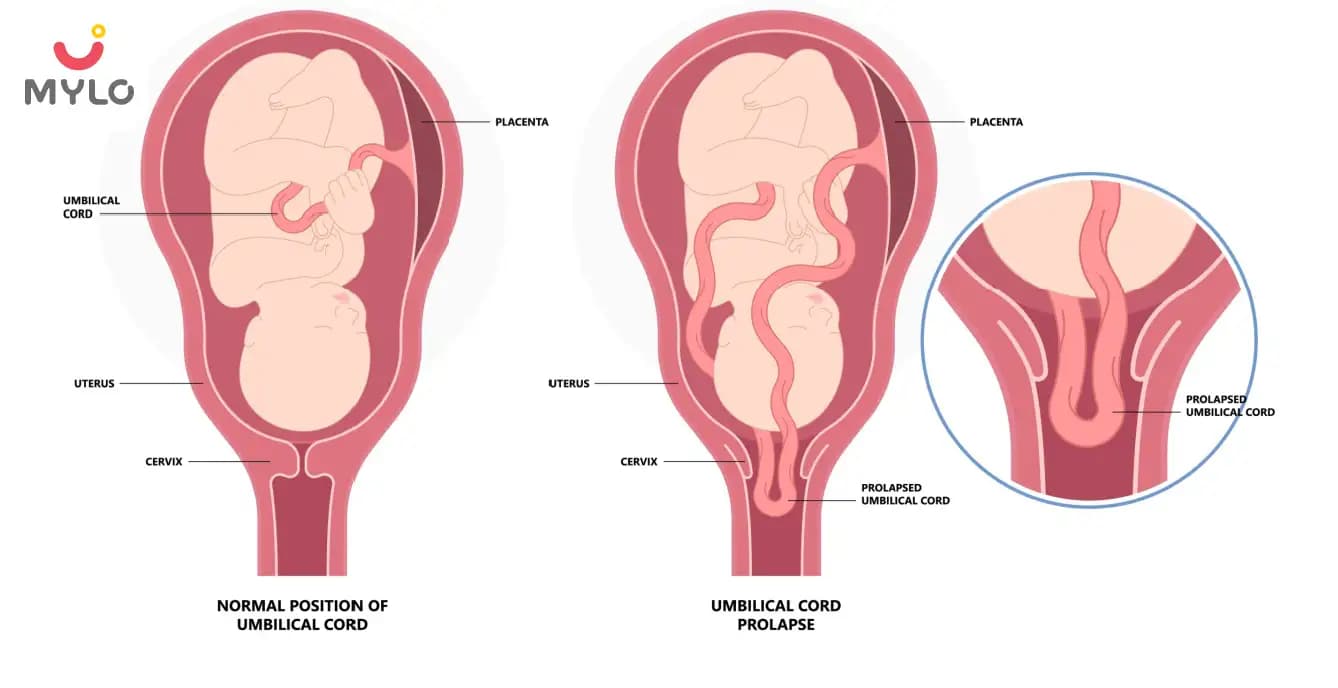
Umbilical cord prolapse occurs when the umbilical cord slips into the birth canal ahead of or alongside the baby after the amniotic membranes rupture (water breaks) (Cleveland Clinic).
The cord carries oxygen and nutrients from the placenta to the baby. When it gets compressed between the baby's body and the wall of the birth canal, blood and oxygen flow to the baby is cut off, which can cause severe fetal distress within minutes (RCOG).
Two Types of Cord Prolapse
| Type | Description |
|---|---|
| Overt prolapse | Cord is visible or felt in the vagina, ahead of the baby |
| Occult (hidden) prolapse | Cord lies alongside the baby's head but is not visible |
Occult prolapse may only be diagnosed through fetal heart rate changes on monitoring, since the cord is not visible.
What Causes Umbilical Cord Prolapse?
The single most common cause is rupture of membranes before the baby's head is fully engaged in the pelvis (ACOG).
Other contributing factors include (Mayo Clinic) (NCBI):
| Cause / Risk Factor | How It Increases Risk | Source |
|---|---|---|
| Premature rupture of membranes (PROM) | Sudden water flow can wash the cord down | ACOG |
| Breech or transverse presentation | Baby's head does not block the cord | RCOG |
| Polyhydramnios (excess amniotic fluid) | More fluid pressure pushes cord down | Cleveland Clinic |
| Prematurity (before 37 weeks) | Baby is smaller, leaving room for cord | NCBI |
| Multiple pregnancy (twins/triplets) | More cord, less space | ACOG |
| Long umbilical cord | Increased physical possibility | NCBI |
| Low birth weight or small for gestational age | Smaller fetus, more cord movement | Cleveland Clinic |
| Unstable lie (head not engaged) | Cord can slip past head | RCOG |
| Artificial rupture of membranes (amniotomy) | Procedure-related risk | RCOG |
| Placental abnormalities (low-lying) | Affects cord position | NCBI |
What Are the Symptoms of Umbilical Cord Prolapse?
Symptoms can appear suddenly during labour, especially after the water breaks (Cleveland Clinic):
What the Mother May Feel
- Sudden sensation of something slipping out of the vagina after water breaks
- Visible cord between the legs (overt prolapse)
- Strong, persistent urge to push before full dilation
- Sudden change in baby's movements (decreased or increased)
What Doctors May Detect
- Sudden, severe drop in baby's heart rate (fetal bradycardia) on monitor
- Variable decelerations on cardiotocography (CTG)
- Cord felt during vaginal examination
- Fetal distress patterns
Emergency sign: A sudden, prolonged drop in baby's heart rate immediately after water breaks should be considered cord prolapse until proven otherwise (RCOG).
How Is Umbilical Cord Prolapse Diagnosed?
Diagnosis happens during labour, not before. Methods include (ACOG) (Cleveland Clinic):
1. Vaginal Examination (Primary Diagnosis)
- Doctor or midwife feels the cord ahead of or alongside the baby
- Most reliable method for overt prolapse
2. Continuous Fetal Heart Rate Monitoring (CTG)
- Sudden bradycardia or variable decelerations
- Often the first sign of occult prolapse
3. Visual Examination
- Cord visible at the vaginal opening
- Often described as a "loop of bluish or grey tissue"
4. Doppler Ultrasound (Rarely Used in Emergency)
- May identify occult prolapse in non-emergency settings
- Not used during acute emergency due to time constraints
What Is the Emergency Treatment for Cord Prolapse?
Cord prolapse requires immediate action within minutes. Standard protocol (RCOG) (ACOG):
Step 1: Call for Emergency Help
- Activate obstetric emergency code
- Notify operating theatre, anaesthesia and neonatal team
Step 2: Relieve Pressure on the Cord
- Mother on hands and knees with bottom raised (knee-chest position) OR
- Trendelenburg position (head tilted down)
- Doctor or midwife may manually lift the baby's head off the cord with fingers
- DO NOT push the cord back into the vagina
- DO NOT handle the cord excessively (causes vasospasm)
- Keep the exposed cord moist and warm
Step 3: Tocolytics (Stop Contractions)
- Medication like terbutaline may be given to reduce uterine contractions and ease pressure (NCBI)
Step 4: Bladder Filling
- Filling the maternal bladder with saline can lift the presenting part off the cord (RCOG)
Step 5: Emergency Caesarean Section
- Definitive treatment
- Standard target: delivery within 30 minutes of diagnosis (RCOG)
- Faster (under 20 minutes) preferred when fetal heart rate is severely compromised
Step 6: Vaginal Delivery (In Rare Cases)
- If the cervix is fully dilated and vaginal delivery is imminent
- Instrumental (forceps or vacuum) delivery may be performed
What Are the Risks and Complications?
If untreated or delayed, cord prolapse can cause (Cleveland Clinic) (RCOG):
For the Baby
- Fetal hypoxia (oxygen deprivation)
- Hypoxic-ischemic encephalopathy (HIE) and brain damage
- Cerebral palsy in survivors with severe hypoxia
- Stillbirth if delivery is delayed
- Neonatal seizures
- Long-term neurodevelopmental issues
For the Mother
- Risks of emergency caesarean section (bleeding, infection, anaesthesia complications)
- Psychological distress from emergency situation
- Future delivery considerations
Outcomes are significantly better when decision-to-delivery interval is less than 30 minutes, especially in hospital settings with continuous fetal monitoring (RCOG).
Can Umbilical Cord Prolapse Be Prevented?
Complete prevention is not possible, but risk reduction strategies include (ACOG):
| Strategy | Why It Helps |
|---|---|
| Avoid artificial rupture of membranes (amniotomy) when head is not engaged | Reduces chance of cord washing down |
| External cephalic version (ECV) for breech babies | Lower risk presentation at birth |
| Hospital delivery for high-risk pregnancies | Faster emergency response |
| Continuous fetal monitoring during labour | Detects occult prolapse early |
| Planned caesarean for transverse lie or unstable presentations | Avoids labour-related cord prolapse |
| Avoid home birth in high-risk cases | Hospital access matters in emergency |
| Pre-delivery counselling for women with polyhydramnios | Awareness of warning signs |
| Regular antenatal ultrasounds | Identifies risk factors (cord position, fluid level, baby position) |
What Should You Do If You Suspect Cord Prolapse at Home?
If you are pregnant, your water has broken, and you suddenly feel something coming out of your vagina (Cleveland Clinic) (RCOG):
Immediate Actions
- Call emergency services (108 in India, 911 in US, 999 in UK) immediately
- Get into knee-chest position (kneel down with chest on floor and bottom in air)
- Do NOT touch or push back the cord
- Do NOT eat or drink anything (in case caesarean is needed)
- Stay calm and breathe slowly
- If you can see the cord, cover with a warm, moist cloth (do not handle excessively)
- Have someone arrange immediate hospital transport
- Continue knee-chest position during ambulance ride
Most ambulance services in India and globally are trained to manage suspected cord prolapse during transport.
Indian Context: What Indian Mothers Should Know
- Incidence in India: Cord prolapse affects an estimated 0.1 to 0.6% of deliveries in Indian hospitals (FOGSI)
- Government emergency hotline: Dial 108 for ambulance with maternity emergency support
- Janani Suraksha Yojana (JSY): Covers free institutional delivery for high-risk pregnancies in government hospitals
- AIIMS protocol: Major Indian teaching hospitals follow FOGSI and RCOG-aligned cord prolapse protocols
- Home birth risk: Cord prolapse during home birth carries a much higher risk of fetal death due to delayed transport. FOGSI recommends hospital delivery for all high-risk pregnancies
- Rural India challenge: Distance to facility with caesarean capability matters. Discuss your nearest emergency obstetric centre with your doctor before labour
- Insurance: Most Indian health insurance plans cover emergency obstetric caesarean section under maternity benefits
When Should You Worry About Cord Prolapse Risk?
Speak to your obstetrician before labour if you have (ACOG) (RCOG):
- Breech or transverse baby position at 36 weeks or later
- Polyhydramnios confirmed on ultrasound
- Twin or multiple pregnancy
- Premature labour or preterm rupture of membranes
- Unstable lie (baby keeps changing position)
- Low-lying placenta or marginal placenta previa
- Long umbilical cord noted on ultrasound
- Previous cord prolapse in past pregnancy
Discuss your delivery plan, hospital choice and emergency contact protocol with your doctor at every prenatal visit if you have risk factors.
Myths vs Facts About Umbilical Cord Prolapse
| Myth | Fact | Source |
|---|---|---|
| "Cord prolapse can be prevented by lifestyle" | Mostly false. Risk factors are structural and presentation-related | ACOG |
| "I can push the cord back myself" | NEVER push the cord back; this causes vasospasm and worsens outcome | RCOG |
| "Cord prolapse happens slowly" | False. It is a sudden, time-critical emergency | Cleveland Clinic |
| "Vaginal birth is always possible after cord prolapse" | False in most cases; emergency caesarean is usually required | RCOG |
| "Home birth is safe with cord prolapse plan" | False. Cord prolapse cannot be managed safely at home | FOGSI |
| "Cord prolapse always causes brain damage" | False. With rapid intervention, outcomes are usually good | NCBI |
| "Only the first baby of twins is at risk" | False. The second twin has a higher cord prolapse risk after first delivery | RCOG |
FAQs: Umbilical Cord Prolapse
How common is umbilical cord prolapse?
Umbilical cord prolapse occurs in approximately 1 in every 300 to 1000 deliveries (NCBI). It is uncommon but considered a critical obstetric emergency due to the risk of fetal hypoxia.
Umbilical cord prolapse kya hota hai? (Hinglish)
Umbilical cord prolapse ek serious labour emergency hai jismein water break hone ke baad cord baby ke head se pehle birth canal mein aa jata hai. Isse baby ko oxygen supply ruk sakti hai. Ye 300 mein se 1 delivery mein hota hai aur turant emergency caesarean section karna padta hai. Risk factors hain: breech baby, polyhydramnios, premature delivery aur twin pregnancy.
Can umbilical cord prolapse happen before water breaks?
No. Umbilical cord prolapse only occurs after the amniotic membranes rupture. The cord cannot move down past the baby while the membranes are intact (ACOG). However, cord presentation (cord positioned near cervix before water breaks) can be a warning sign visible on ultrasound.
Can the baby survive cord prolapse?
Yes, most babies survive with prompt treatment (RCOG). When emergency caesarean is performed within 30 minutes of diagnosis, neonatal outcomes are usually good. Survival rates are highest when prolapse occurs in hospital with continuous fetal monitoring.
What position should I assume if cord prolapse happens?
The recommended position is knee-chest (kneeling with chest down and bottom up) to use gravity to relieve pressure on the cord (Cleveland Clinic). The Trendelenburg position (lying on back with feet elevated) is an alternative used in hospital settings.
Can cord prolapse happen during a C-section?
No. Cord prolapse is a complication of vaginal labour or early labour after water breaks. During a planned caesarean, the baby is delivered through the abdominal wall before the cord can prolapse.
Will I need a C-section in future pregnancies after cord prolapse?
Not automatically. Future delivery mode depends on the cause of the prior prolapse and your current pregnancy presentation (ACOG). Many women have successful vaginal deliveries afterward. Discuss with your obstetrician.
Is cord prolapse the same as cord around the neck (nuchal cord)?
No. A nuchal cord (cord wrapped around the neck) is found in about 1 in 3 deliveries and is usually harmless. Cord prolapse is when the cord drops into the birth canal ahead of the baby and is an emergency (Mayo Clinic).
Can I prevent cord prolapse?
You cannot fully prevent cord prolapse, but you can reduce risk by (RCOG):
- Hospital delivery for high-risk pregnancies
- Continuous fetal monitoring during labour
- Avoiding artificial rupture of membranes when baby's head is not engaged
- External cephalic version for breech babies before 39 weeks
What is occult cord prolapse?
Occult cord prolapse happens when the cord slips alongside the baby's head but does not protrude visibly. It is often detected only through sudden fetal heart rate changes on monitoring (Cleveland Clinic).
Cord prolapse hone par baby ko kya hota hai? (Hinglish)
Cord prolapse hone par cord baby ke body aur birth canal ke beech mein dab jata hai, jiss se baby ko oxygen aur blood supply ruk jati hai. Agar 10-15 minute mein delivery na ho, toh baby ko hypoxia (oxygen ki kami) ho sakti hai. Isiliye emergency caesarean turant kiya jata hai, taaki baby ko surakshit nikala ja sake.
How fast does cord prolapse need to be treated?
Within minutes. Standard hospital protocols target delivery within 30 minutes of diagnosis through emergency caesarean section. Outcomes are significantly better when delivery happens within 20 minutes (RCOG).
Can ultrasound detect risk of cord prolapse before labour?
Sometimes. A late-pregnancy ultrasound can identify cord presentation (cord lying near the cervix) and risk factors like polyhydramnios, breech position or low-lying placenta. However, cord prolapse itself happens during labour and cannot be predicted with certainty (RCOG).
References
- Royal College of Obstetricians and Gynaecologists (RCOG). "Umbilical Cord Prolapse, Green-top Guideline No. 50." https://www.rcog.org.uk/guidance/browse-all-guidance/green-top-guidelines/umbilical-cord-prolapse-green-top-guideline-no-50/
- American College of Obstetricians and Gynecologists (ACOG). "Labor and Delivery." https://www.acog.org/womens-health/faqs/labor-and-delivery
- Cleveland Clinic. "Umbilical Cord Prolapse." https://my.clevelandclinic.org/health/diseases/22571-umbilical-cord-prolapse
- Mayo Clinic. "Labor and Delivery Complications." https://www.mayoclinic.org/diseases-conditions/labor-delivery/in-depth/labor-delivery-complications/art-20546538
- NCBI / StatPearls. "Umbilical Cord Prolapse." https://www.ncbi.nlm.nih.gov/books/NBK470546/
- FOGSI (Federation of Obstetric and Gynaecological Societies of India). https://www.fogsi.org/
- NHS UK. "Cord Prolapse and Labour Complications." https://www.nhs.uk/pregnancy/labour-and-birth/
- World Health Organization (WHO). "Maternal Health Guidelines." https://www.who.int/health-topics/maternal-health
Article Posted Under
Related Articles
What Are the Developmental Red Flags From 1 to 3 Years? An Age-by-Age Checklist for Parents (2026)
17 min How to Develop Social Skills in Toddlers: Greeting Elders, Manners and More (2026 Guide for Indian Parents)
 18 min
 Mylo AirPrime Premium Diaper: Certified Hypoallergenic, Non-Irritant & Pediatrician Tested
 9 min
9 min Mylo Baby Body Lotion: Patch Test Certificate
 10 min
Medical Disclaimer
This content is for informational purposes only and should not replace professional medical advice. Consult with a physician or other health care professional if you have any concerns or questions about your health. If you rely on the information provided here, you do so solely at your own risk.


AWARDS AND RECOGNITION

Mylo wins Forbes D2C Disruptor award

Mylo wins The Economic Times Promising Brands 2022
AS SEEN IN













- Mylo Care: Effective and science-backed personal care and wellness solutions for a joyful you.
- Mylo Baby: Science-backed, gentle and effective personal care & hygiene range for your little one.
- Mylo Community: Trusted and empathetic community of 10mn+ parents and experts.


Product Categories
Baby Carrier | Baby Soap | Baby Wipes | Stretch Marks Cream | Baby Cream | Baby Shampoo | Baby Massage Oil | Baby Hair Oil | Stretch Marks Oil | Baby Body Wash | Baby Powder | Baby Lotion | Diaper Rash Cream | Newborn Diapers | Teether | Baby Kajal | Baby Diapers Pants | Cloth Diapers | Laundry Detergent | Lactation Granules |