


Orders
.png&w=48&q=75 "login")
Profile


Wallet

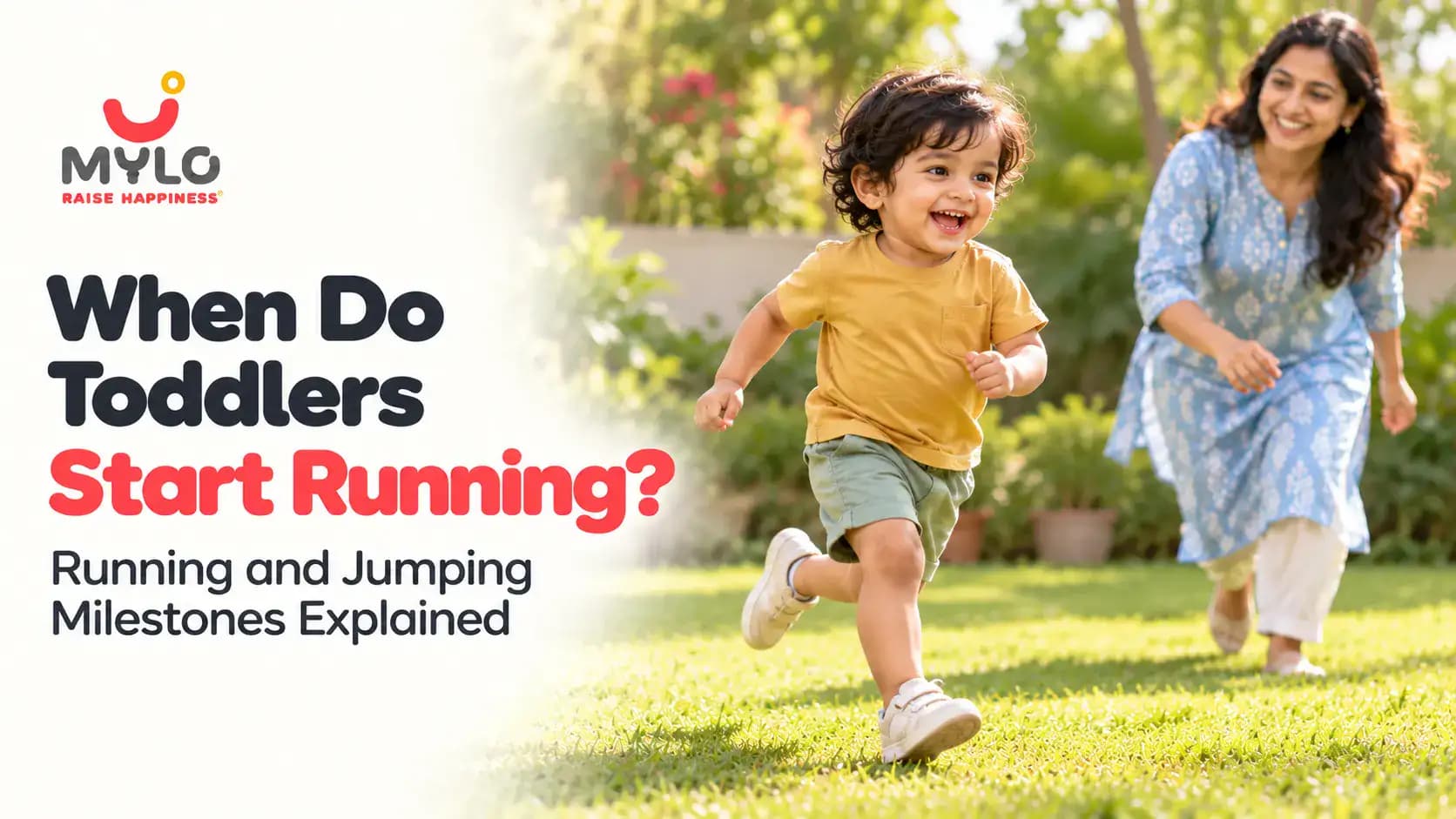
When Do Toddlers Start Running? Running and Jumping Milestones Explained (2026)
 25 Likes|
 13 min
Quick Answer
Most toddlers start running around 18 months, usually stiffly and with lots of falls, and run well by 2 years. By 3, most can run, stop and turn easily. Jumping with both feet usually comes by 30 months. See a doctor if your child isn't walking by 18 months or can't run at all by 2.5 years.
Running and Jumping Milestones at a Glance
Age | Running | Jumping |
|---|---|---|
12 to 15 months | Walking, often wobbly | Bounces while holding on |
16 to 18 months | Fast walking, a stiff "hurry walk" | Bounces on the spot, feet stay down |
18 to 24 months | Starts running, falls often | Tries to jump; one foot may leave first |
2 years | Runs | May jump off the bottom step with help |
30 months | Runs well | Jumps off the ground with both feet |
3 years | Runs, stops and turns easily | Jumps forward, jumps down from a low step |
4 years | Runs around obstacles, speeds up and slows down | Starts hopping on one foot |
Sources: Official AAP and CDC milestone checklists (CDC), Nemours KidsHealth.
Key Facts Every Parent Should Know
Around 18 months: When many toddlers start a stiff, fast "run"
By 2 years: Most toddlers run (Nemours KidsHealth)
By 30 months: Most can jump off the ground with both feet (Nemours KidsHealth)
Walking comes first: Running usually starts about 3 to 6 months after walking alone
Falls are normal: Balance and coordination take months to develop
180 minutes a day: The WHO recommends at least 3 hours of active play a day for children aged 1 to 4
When Do Toddlers Start Running?
Short answer: Most toddlers start running around 18 months, a few months after they begin walking alone. The first "run" is often a stiff, fast walk with arms up and lots of falls. Most toddlers run by 2 years and run smoothly, stopping and turning, by about 3 years.
Running Stage | Typical Age | What It Looks Like |
|---|---|---|
Hurry walk | 16 to 18 months | Fast, stiff steps, arms out for balance |
First running | 18 to 24 months | Short bursts of running, frequent falls |
Runs | By 2 years | Runs across a room or park |
Runs smoothly | 2.5 to 3 years | Fewer falls, arms swing, can stop suddenly |
Runs, stops and turns | Around 3 years | Changes direction, avoids bumping into things |
Runs around obstacles | 3 to 4 years | Speeds up, slows down, runs around objects |
Late walker? If your child walked late, running will usually come a little later too. Most children start running 3 to 6 months after they walk well. See when do babies start walking.
When Do Toddlers Start Jumping?
Short answer: Jumping needs more balance and leg strength than running. Many toddlers try to jump around 2 years, and most can jump off the ground with both feet by 30 months. By 3, many jump forward and down from a low step. Hopping on one foot usually comes around 4 years.
Jumping Stage | Typical Age |
|---|---|
Bounces while holding on | 12 to 18 months |
Bounces on the spot, feet stay down | 18 to 24 months |
Tries to jump; one foot leaves first | Around 2 years |
Jumps off the bottom step with help | 2 to 2.5 years |
Jumps off the ground with both feet | By 30 months |
Jumps forward with both feet | Around 3 years |
Hops on one foot | Around 4 years |
What Does Normal Toddler Running Look Like?
Short answer: Early toddler running often looks clumsy: legs wide apart, arms up, flat-footed steps and frequent falls. This is normal and improves steadily over the next 1 to 2 years.
What You See | Usually Normal? | See a Doctor If |
|---|---|---|
Arms held up or out for balance | Yes | Not applicable |
Wide, flat-footed steps | Yes | Not applicable |
Frequent falls | Yes, at 18 months to 2 years | Falls suddenly increase, or they can't get up easily |
Occasional tiptoe running | Common | Runs and walks only on tiptoes after 2 to 3 years |
Bumps into things | Common | Seems unable to see obstacles (check vision) |
Tires quickly | Common | Very weak, breathless or in pain after short play |
Leans or limps | No | Always check a limp or one-sided running |
How Can I Help My Toddler Run and Jump?
Short answer: Give your toddler lots of safe space and time to move, preferably outdoors on grass or sand. Chasing games, ball play, dancing and gentle obstacle courses build running and jumping skills naturally.
Age | Best Activities | Household Items to Use |
|---|---|---|
15 to 18 months | Walking on grass, pushing a cart, chasing bubbles | A cardboard box to push, bubbles |
18 to 24 months | Chasing games, running to you, kicking a big ball, dancing | A soft ball, music |
2 to 2.5 years | Jumping on the spot, stepping over pillows, "run and stop" games | Pillows, a dupatta laid on the floor |
2.5 to 3 years | Jumping forward, obstacle courses, jumping off the bottom step (held) | Cushions, chalk lines, a low step |
Fun Games Toddlers Love
Pakdam-pakdai (chasing): Great for running and changing direction
Red light, green light ("ruko aur chalo"): Run on green, stop on red. Builds control and listening.
Jump like a frog or kangaroo: Makes jumping fun
Bubble chase: Running and reaching
Follow the leader: Run, hop, tiptoe and stomp
Jumping over a line: Draw a chalk line or lay a dupatta on the floor
Tips
Barefoot indoors helps balance. Use soft, flexible shoes outdoors.
Soft surfaces like grass, sand and mats make falls less scary
Praise effort: "You ran so fast!"
Limit screens and long stroller rides. The WHO advises young children not be restrained for more than 1 hour at a time.
How Do I Keep My Running Toddler Safe?
Short answer: New runners are fast but don't understand danger. Hold hands near roads and parking areas, use stair gates, teach a "stop" game and choose soft, safe spaces for play.
Risk | How to Prevent It |
|---|---|
Running into roads or parking areas | Always hold hands; practise "stop" games at home |
Running away in crowded places | Hold hands, or use a safety wrist strap in crowds |
Falls on hard floors | Play on grass, sand or mats |
Running with objects in the mouth | No running with food, lollipops, pens or sticks |
Stairs and balconies | Stair gates, window and balcony guards |
Slippery floors | Barefoot or non-slip socks; wipe spills quickly |
Emergency number: Dial 108 for ambulance services in most states, or 112 for emergencies.
When Should I Worry About My Toddler's Running?
Short answer: Talk to your doctor if your child isn't walking by 18 months, can't run at all by about 2.5 years, can't jump with both feet by 3 years, limps or uses one leg more, walks or runs only on tiptoes after 2 to 3 years, falls much more than other children, or loses skills they had.
Age | Red Flag |
|---|---|
Any age | Loses running or walking skills (see a doctor right away) |
Any age | Limps, or uses one side of the body more than the other |
Any age | Seems very weak, floppy or stiff, or has pain when moving |
18 months | Not walking alone |
2.5 years | Not running at all |
2 to 3 years | Walks or runs only on tiptoes, falls very often |
3 years | Can't jump with both feet, very clumsy compared with peers |
Who can help? Your pediatrician first. They may refer you to a pediatric physiotherapist or an orthopaedic specialist. Free assessment and physiotherapy are available at District Early Intervention Centres (DEIC) under RBSK.
Myths vs Facts
Myth | Fact |
|---|---|
"Toddlers should run as soon as they walk" | Running usually comes 3 to 6 months after walking |
"Frequent falls mean something is wrong" | Falls are normal while balance develops |
"Baby walkers help children run sooner" | Walkers don't help walking or running, and they cause injuries |
"Shoes help toddlers run better" | Barefoot is best indoors; soft shoes outdoors |
"Late runners will be bad at sports" | Early running age doesn't predict sporting ability |
"Tiptoe running always means a problem" | Occasional tiptoe running is common; check it only if constant after 2 to 3 years |
FAQs: When Do Toddlers Start Running?
When do toddlers start running?
Most start running around 18 months and run well by 2 years.
Bachcha kab daudna shuru karta hai? (Hinglish)
Zyada tar bachche lagbhag 18 mahine mein daudna shuru karte hain, shuru mein thoda akad kar aur girte-padte. 2 saal tak aaram se daudne lagte hain, aur 3 saal tak daud kar rukna aur mudna bhi seekh jaate hain.
When do toddlers start jumping?
Most can jump off the ground with both feet by 30 months.
Is it normal for my toddler to fall a lot while running?
Yes, especially between 18 months and 2 years. Falls decrease as balance improves.
My 2-year-old doesn't run yet. Should I worry?
Some toddlers take a little longer. Talk to your doctor if your child can't run at all by about 2.5 years, or has other motor concerns.
Is tiptoe running normal?
Occasional tiptoe running is common. See a doctor if your child walks or runs only on tiptoes after 2 to 3 years.
When do children hop on one foot?
Usually around 4 years.
Mera 2.5 saal ka bachcha nahi daudta, kya karein? (Hinglish)
Agar bachcha 2.5 saal tak bilkul nahi daudta, bahut girta hai, lagatar panjon par chalta hai ya ek pair zyada use karta hai, toh doctor se milein. Physiotherapy se bahut madad milti hai. Roz park mein khelne dein aur mobile kam karein.
How can I help my toddler run?
Give lots of outdoor play, chasing games, ball play and dancing. Let them go barefoot indoors and limit stroller and screen time.
Related Reads on Mylo
Gross Motor Milestones From 1 to 3 Years (link once live)
References
Nemours KidsHealth. "2-Year Well-Child Checkup." https://kidshealth.org/en/parents/checkup-2yrs.html
Nemours KidsHealth. "30-Month Well-Child Checkup." https://kidshealth.org/en/parents/checkup-30mos.html
Nemours KidsHealth. "18-Month Well-Child Checkup." https://kidshealth.org/en/parents/checkup-18mos.html
World Health Organization (WHO). "Guidelines on Physical Activity, Sedentary Behaviour and Sleep for Children Under 5 Years of Age." https://www.ncbi.nlm.nih.gov/books/NBK541173/
Centers for Disease Control and Prevention (CDC). "Milestones by 2 Years." https://www.cdc.gov/act-early/milestones/2-years.html
Medical Disclaimer
This article is for information only and does not replace professional medical advice. Every child develops at their own pace. If you have concerns about your child's running, walking, balance or legs, please consult your pediatrician.


Article Posted Under
Related Articles
Baby Growth: When Do Growth Spurts Occur in Babies?
 41·5 min
 When Do Babies and Toddlers Start Walking? Age, Stages, Signs and Tips (2026)
 16·16 min
 Baby Growth Stages Month-by-Month (0 to 12): The Complete 2026 Chart with Milestones, Weight, Height & Development Guide
 100·18 min
 Baby Milestones: A Week-By-Week Guide to Your Baby’s Development in the First Year
 58·5 min
Related Topics
.webp&w=32&q=75)
Medical Disclaimer
This content is for informational purposes only and should not replace professional medical advice. Consult with a physician or other health care professional if you have any concerns or questions about your health. If you rely on the information provided here, you do so solely at your own risk.


AWARDS AND RECOGNITION

Mylo wins Forbes D2C Disruptor award

Mylo wins The Economic Times Promising Brands 2022
AS SEEN IN













- Mylo Care: Effective and science-backed personal care and wellness solutions for a joyful you.
- Mylo Baby: Science-backed, gentle and effective personal care & hygiene range for your little one.
- Mylo Community: Trusted and empathetic community of 10mn+ parents and experts.


Product Categories
Baby Carrier | Baby Soap | Baby Wipes | Stretch Marks Cream | Baby Cream | Baby Shampoo | Baby Massage Oil | Baby Hair Oil | Stretch Marks Oil | Baby Body Wash | Baby Powder | Baby Lotion | Diaper Rash Cream | Newborn Diapers | Teether | Baby Kajal | Baby Diapers Pants | Cloth Diapers | Laundry Detergent | Lactation Granules |