


Orders
.png&w=48&q=75 "login")
Profile


Wallet

7 Signs of Labour: Know What to Expect

MBBS, DGO · 38 years experience

 773 Likes|
 16 min
Quick answer
Labour usually begins with contractions that come in a rhythm and get stronger, your waters breaking, or a show. Some signs, like shivering or loose stools, arrive in the hours before. Call your hospital as soon as your waters break, if you have any bleeding, if contractions start before 37 weeks, or if your baby's movements change. From there, labour has three stages, and the first is the longest.
Key takeaways
Regularity is what separates labour from practice contractions. Braxton Hicks are irregular and settle with rest. Labour contractions come in a rhythm and keep building.
Waters breaking means calling your hospital straight away, even with no contractions. Note the time, colour and smell.
Early labour is the longest and least dramatic part. Most of it happens at home, and resting through it matters more than timing every contraction.
Shivering, shaking and nausea are normal in labour, particularly in transition. They frighten people and usually mean things are progressing.
Before 37 weeks, any regular tightening is an emergency until a doctor says otherwise.
What does labour mean?
Labour is the process by which your uterus contracts, your cervix opens, and your baby is born. It happens in three stages, and for most women the first stage is by far the longest.
Full term is 37 weeks onward. Only a small proportion of babies arrive on their estimated due date, and anywhere from 37 to 42 weeks is within the normal range. If you reach 41 weeks, your doctor will usually discuss induction, which our guide to what the evidence says about bringing on labour explains in more detail.
The 7 signs of labour
1. Your waters break
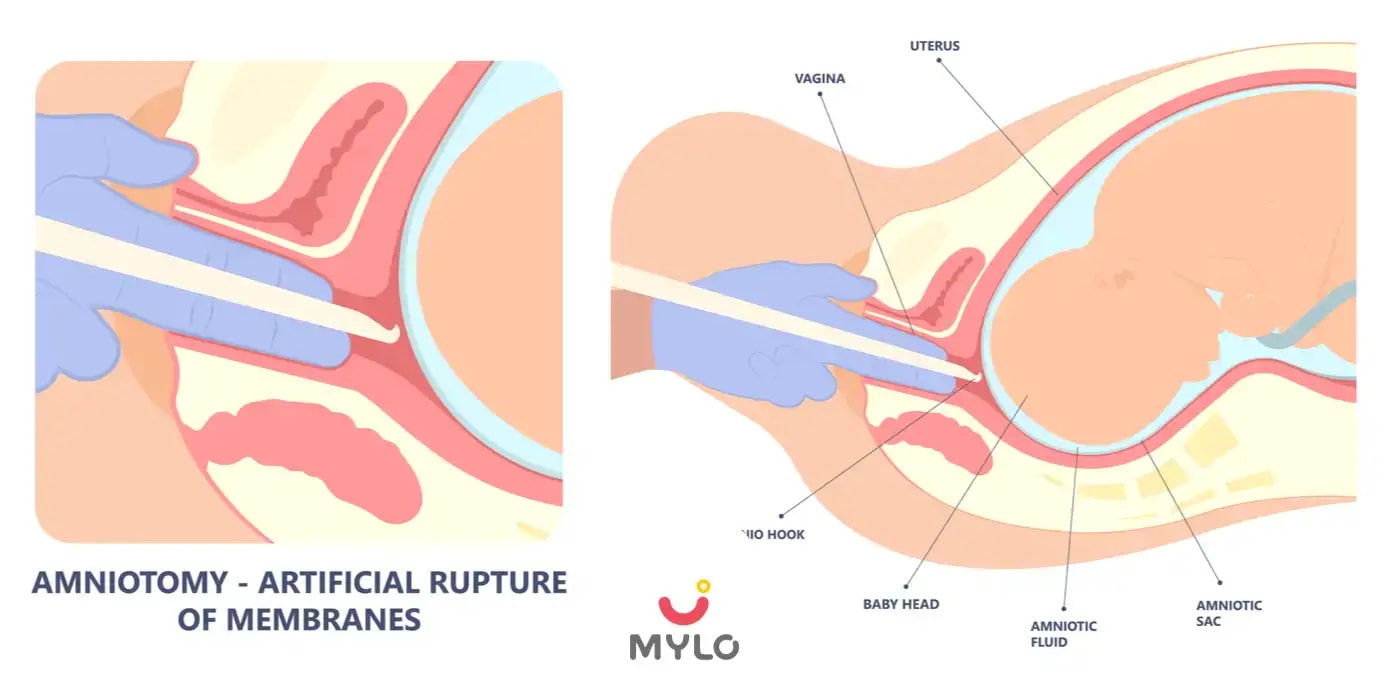
Also called spontaneous rupture of membranes. The sac of fluid around your baby breaks, either as a sudden gush or a slow trickle you cannot control. It differs from urine because it keeps coming and does not smell like urine.
What to do immediately:
Note the time
Note the colour. Clear or slightly pink is usual
Note the smell. It should not smell unpleasant
Put on a pad, never a tampon
Call your hospital straight away, even if you have no contractions
🚩 Go in urgently if the fluid is green, brown or foul-smelling, if there is bleeding, if it happens before 37 weeks, or if you feel anything in the vagina after your waters break. That last situation is rare but is an emergency, so call an ambulance and, if you can, get onto your hands and knees with your chest down while you wait.
What to expect next: labour often starts within hours. If it does not, your hospital will advise you, since there is a time limit after which they will usually recommend starting labour to reduce infection risk.
2. Contractions that build
The defining sign of labour. What matters is not how strong the first ones feel but whether they come in a rhythm and keep progressing.
Real labour contractions:
Come at regular intervals, and the gaps get shorter
Get longer and stronger over time
Do not settle with rest, a change of position or a warm bath
Often start in the back and wrap around to the front
Make it difficult to talk through them as they build
Time them: note when each one starts and how long it lasts. An app helps, but pen and paper works just as well.
3. A show
The plug of mucus sealing your cervix comes away, either in one piece or gradually over days, often tinged pink or brown with a little blood.
What to expect next: labour may follow within hours or may still be days away. A show alone is not a reason to go in.
🚩 A blood-streaked mucus show is normal. Fresh red bleeding, or anything soaking a pad, is not and needs immediate assessment.
4. Shivering and shaking
Uncontrollable shivering, teeth chattering or shaking legs, often without feeling cold. This is common in labour, particularly as it intensifies, and it is caused by hormonal and physiological changes rather than by illness.
It frightens people because it looks alarming, and it usually means labour is progressing. Tell your midwife or doctor, keep warm, and breathe slowly.
🚩 Shivering with a fever is different and needs to be reported, since it may indicate infection.
5. Looser joints and pelvic pressure
Your pelvic joints soften and ligaments relax in preparation for birth. You may feel more pressure low down, a heavier sensation in the pelvis, or a sense that your baby has dropped.
If this comes with pain over the pubic bone or difficulty standing on one leg, that may be pelvic girdle pain rather than labour, which our guide to back and pelvic pain in pregnancy covers.
6. Loose stools or nausea
Many women have loose stools, nausea or vomiting in the day or two before labour, and again during it. This is normal and is caused by hormones that affect the bowel as well as the uterus.
What to expect next: eat lightly and keep sipping fluids. Do not take anti-diarrhoeal medicine without asking your doctor.
7. Pain that intensifies and moves to the back
As labour establishes, contractions become more painful, longer and closer together. Many women feel it most in the lower back, particularly if the baby is facing their spine, which is often called back labour.
🚩 Back pain that comes and goes in a rhythm before 37 weeks is one of the most commonly missed signs of preterm labour, because it gets dismissed as an ordinary bad back. Call your hospital.
Is it real labour or false labour?
Braxton Hicks (false labour) | Real labour | |
|---|---|---|
Pattern | Irregular, unpredictable | Regular, with shortening gaps |
Over time | Stay the same or fade | Get longer, stronger, closer |
Position change | Settle with rest, walking or a warm bath | Do not settle |
Pain location | Usually front of the abdomen | Often starts in the back, wraps to the front |
Intensity | Tightening rather than pain | Increasingly painful |
Other signs | None | Show, waters breaking, pressure |
The simplest test: change what you are doing. Walk if you were resting, or rest if you were active. Braxton Hicks usually stop. Labour does not.
What to expect: the three stages of labour
First stage: the cervix opens
The longest stage, and it has three parts.
Phase | What happens | Roughly how long |
|---|---|---|
Early labour | Contractions start and become regular. Cervix softens and opens to around 4 to 6 cm | Hours to a couple of days in a first labour. Usually spent at home |
Active labour | Contractions are strong, regular and close. Cervix opens from around 6 cm to 10 cm | Often 4 to 8 hours in a first labour, faster in later ones |
Transition | The last few centimetres. The most intense part | Usually the shortest, often 15 minutes to an hour |
What early labour feels like: manageable at first, with contractions perhaps 10 to 20 minutes apart. You can usually talk, eat and move around.
What to do in early labour: rest, especially at night. Eat light food, keep sipping fluids, move around and try a warm shower for comfort. Time contractions, but not obsessively. This part can take a long time, and conserving energy matters more than anything else you do.
What transition feels like: many women shake, feel sick, feel very hot or very cold, and say they cannot continue. That feeling is itself a recognised sign that you are nearly there.
Second stage: pushing and birth
From full dilation to your baby being born.
You will feel a strong urge to push with each contraction
Usually up to two to three hours in a first labour, often much less in later ones, and sometimes longer with an epidural
Your team will guide you on when and how to push
Upright, kneeling, side-lying and squatting positions are all used. Ask what is possible where you are delivering
You may be offered an episiotomy, a small cut to widen the opening. It is not routine and should be discussed with you. Ask beforehand what your hospital's practice is
Your baby is born, usually placed straight onto your chest
Third stage: delivering the placenta
Usually 5 to 30 minutes after birth
Often managed actively with an injection to help the uterus contract and reduce bleeding
You may barely notice it
In the first hour after birth, you can usually expect delayed cord clamping, skin-to-skin contact, and a first feed. Our guide to feeding after a caesarean covers what changes if you have surgery.
What to expect when you arrive at hospital
Knowing the sequence removes a lot of anxiety.
Checks on arrival: blood pressure, temperature, pulse, urine sample, and a hand examination of your abdomen to feel your baby's position
Your baby's heartbeat will be listened to, either intermittently or continuously on a monitor
A vaginal examination to assess how far your cervix has opened. You can ask how often these will be done
A cannula may be placed in your hand in some hospitals
Pain relief options will be discussed. These typically include breathing and movement, a warm shower, massage, injectable pain relief, and an epidural where available. Ask what your hospital offers, and when in labour each can be given
You may be sent home if you are in early labour and everything is well. This is normal and not a failure
Two things worth asking in advance:
Can a birth companion stay with me? Continuous support during labour is recommended by the World Health Organization and is associated with better outcomes, but practice varies between Indian hospitals, so ask rather than assume
What are your routine practices on episiotomy, positions for pushing, and mobility during labour?
If you are delivering at a government facility, care and delivery services are free, and schemes such as Janani Shishu Suraksha Karyakram cover delivery, drugs, diagnostics and transport for eligible women.
When to go to the hospital
Ask your own hospital for their rule at your next appointment and write it down, because it varies considerably.
A common general guide for a first labour: contractions about 5 minutes apart, each lasting about 1 minute, continuing for 1 hour.
Go in sooner if:
Your waters have broken, at any stage
This is not your first baby, since later labours are often faster
Your previous labour was fast
You have had a caesarean before
You live far from the hospital, or traffic is unpredictable. In Indian cities a 20 minute route can become an hour without warning
Your pregnancy has been marked high risk, or you are expecting twins
You are frightened or unsure. That is a valid reason on its own
🚩 Go immediately, whatever your contraction pattern, for:
Any bleeding
Waters that are green, brown or foul-smelling
Contractions before 37 weeks
Reduced or changed baby movements
Severe headache with visual changes, pain under the ribs, or sudden swelling of the face and hands
Constant, severe abdominal pain that does not come and go
Fever
Fainting or heavy dizziness
A fall or blow to the abdomen
Our full guide to pregnancy warning signs sorted by urgency covers these in detail.
Your baby's movements still matter during labour
This is the sign most often forgotten once attention shifts to contractions.
Your baby should keep moving as usual right up to and through early labour. A reduction or change in the pattern needs same-day assessment, whatever else is happening.
Do not wait until morning
Do not try to wake the baby first with cold drinks, sugar or lying down. These waste time
Do not accept that the baby has run out of room. Reduced movement is not caused by lack of space
Be ready before it starts
Save the numbers now: your hospital's labour ward, your doctor, and the ambulance services 102 and 108
Keep your antenatal records with you at all times from 36 weeks
Have your bag packed by 36 weeks. Our third trimester guide covers what to include
Know the route and travel time at different times of day, plus a backup plan
Agree who is taking you, and a second option
Tell one family member the warning signs, so someone else recognises them
Do not drive yourself if you have bleeding, severe pain, visual changes or dizziness
Frequently asked questions
What are the first signs of labour?
Usually contractions that come in a rhythm and get stronger, your waters breaking, or a show. Looser joints, shivering and loose stools can come in the hours before.
How do I know if my contractions are real?
Real contractions come in a rhythm, get longer and stronger, and do not settle when you rest or change position. Braxton Hicks are irregular and usually stop.
My waters broke but I have no contractions. What should I do?
Call your hospital straight away. Note the time, colour and smell, use a pad rather than a tampon, and follow their instructions.
Is shivering normal during labour?
Yes. Shivering and shaking are common, especially in transition, and usually mean labour is progressing. Shivering with a fever is different and should be reported.
Why do I have loose motions before labour?
Hormones that prepare the uterus also affect the bowel. Loose stools and nausea before and during labour are normal.
How long does labour last?
The first stage is longest, often many hours in a first labour. Pushing can take up to two to three hours with a first baby, and the placenta usually follows within 30 minutes of birth. Later labours are generally faster.
What is transition?
The final part of the first stage, when the cervix opens the last few centimetres. It is the most intense phase, often with shaking and nausea, and it is usually the shortest.
When exactly should I leave for the hospital?
Ask your own hospital for their rule. A common guide for a first labour is contractions five minutes apart, lasting a minute, for an hour. Go sooner if your waters have broken, this is not your first baby, you live far away, or you have any warning sign.
What if I go in and it is a false alarm?
That is a good outcome, not a wasted trip. Maternity units expect it, and being assessed and sent home is exactly what should happen.
Does the baby move less when labour is near?
No. Your baby should keep moving as usual. Any reduction or change needs same-day assessment.
The bottom line
Labour usually announces itself through contractions that come in a rhythm and keep building, and the simplest test is that real labour does not settle when you rest or change position. Everything else, including shivering, loose stools and looser joints, tends to arrive alongside or just before. Expect the first stage to be long and mostly spent at home, and save your energy for the part that needs it. Whatever else is happening, four situations mean going in immediately: waters breaking, any bleeding, contractions before 37 weeks, and any change in your baby's movements.
Sources
World Health Organization, Intrapartum care for a positive childbirth experience
American College of Obstetricians and Gynecologists, How to tell when labor begins
Royal College of Obstetricians and Gynaecologists, Reduced fetal movements
National Institute for Health and Care Excellence, Intrapartum care, and Preterm labour and birth
Centers for Disease Control and Prevention, Urgent maternal warning signs
Federation of Obstetric and Gynaecological Societies of India, intrapartum care recommendations
Ministry of Health and Family Welfare, Government of India, LaQshya and Janani Shishu Suraksha Karyakram
This article is for general information and is not a substitute for professional medical advice. Go to hospital immediately if your waters break, you have any bleeding, contractions start before 37 weeks, or your baby's movements change.
Article Posted Under
Related Articles
Preterm Labor: Signs, Symptoms, Causes, Risks and Treatment
 42·17 min
 Are you aware of these top 10 signs and symptoms of Labor?
 633·5 min
 Inducing labor - How it works, what you should expect and its importance for a safe natural delivery
 257·3 min
 What are the Symptoms and Causes of a Premature Delivery & How to Prevent it?
 82·6 min
Related Topics
.webp&w=32&q=75)
Medical Disclaimer
This content is for informational purposes only and should not replace professional medical advice. Consult with a physician or other health care professional if you have any concerns or questions about your health. If you rely on the information provided here, you do so solely at your own risk.


AWARDS AND RECOGNITION

Mylo wins Forbes D2C Disruptor award

Mylo wins The Economic Times Promising Brands 2022
AS SEEN IN













- Mylo Care: Effective and science-backed personal care and wellness solutions for a joyful you.
- Mylo Baby: Science-backed, gentle and effective personal care & hygiene range for your little one.
- Mylo Community: Trusted and empathetic community of 10mn+ parents and experts.


Product Categories
Baby Carrier | Baby Soap | Baby Wipes | Stretch Marks Cream | Baby Cream | Baby Shampoo | Baby Massage Oil | Baby Hair Oil | Stretch Marks Oil | Baby Body Wash | Baby Powder | Baby Lotion | Diaper Rash Cream | Newborn Diapers | Teether | Baby Kajal | Baby Diapers Pants | Cloth Diapers | Laundry Detergent | Lactation Granules |